Step-by-Step Guide to Lorikeet Security for SaaS Pros
From PDF Reports to Live Defense: Shipping Secure SaaS with Lorikeet Security
Stat hook: IBM’s 2024 report pegs the average data breach at $4.88M—yet teams still spend weeks stitching together pentest PDFs, spreadsheets, and compliance checklists. Lorikeet Security consolidates offensive testing, 24/7 attack surface monitoring, and audit readiness into one platform, so SaaS teams can cut mean time to remediation (MTTR) without drowning in noise. While Flowtriq excels at instant DDoS detection and auto-mitigation to keep uptime high, Lorikeet is better suited for finding and fixing logic flaws, auth gaps, and cloud misconfigs that drive real breach risk. Our analysis: it’s a Chill Pick for builders who need Easy Setup Tools and measurable outcomes.
Step 1: Setting Up Your Account
- Create your workspace: Invite security, platform, and lead developers. Enable SSO so you can enforce MFA and role-based access.
- Baseline your attack surface:
- Add domains, subdomains, IP ranges, and cloud accounts (AWS/Azure/GCP).
- Tag assets by environment (prod, staging), criticality (P0–P3), and owner team.
- Scope your first engagement:
- Choose targets: web apps, APIs (REST/GraphQL/SOAP), mobile, desktop/thick clients, or AI agent assessments.
- For infra: networks, cloud, AD, containers/Kubernetes, or wireless.
- Pick specialized tests if needed: red team, social engineering, physical, IoT, blockchain, or vibe coding security reviews for AI-coded apps.
- Turn on continuous monitoring: Enable the 24/7 attack surface module to watch for new exposures.
- Connect dev workflows: Set up Jira tickets and Slack/MS Teams alerts for new findings and retest confirmations.
Time-to-value goal: reach a live dashboard with at least 80% of prod assets tagged and monitored inside one week.
Step 2: Core Features You Need to Know
- Manual-first penetration testing
- 100% human-led research reduces false positives.
- Free retesting verifies fixes—schedule retest windows aligned with your sprints.
- Deliverables include step-by-step remediation for engineers and auditors.
- Continuous attack surface monitoring
- Track newly exposed services, expired certs, shadow subdomains, and risky ports.
- Practical example: detect a stray test S3 bucket set to public after a weekend deploy; auto-create a P1 Jira.
- Compliance automation and partners
- Map controls across SOC 2, PCI-DSS, ISO 27001, HIPAA, GDPR, FedRAMP, NIS2, DORA, SOX, and more.
- Integrations: Vanta and Drata; audit support via Accorp Partners CPA for SOC 2/ISO 27001.
- Practical example: pull pentest evidence directly into SOC 2 Control CC6.6 without reformatting.
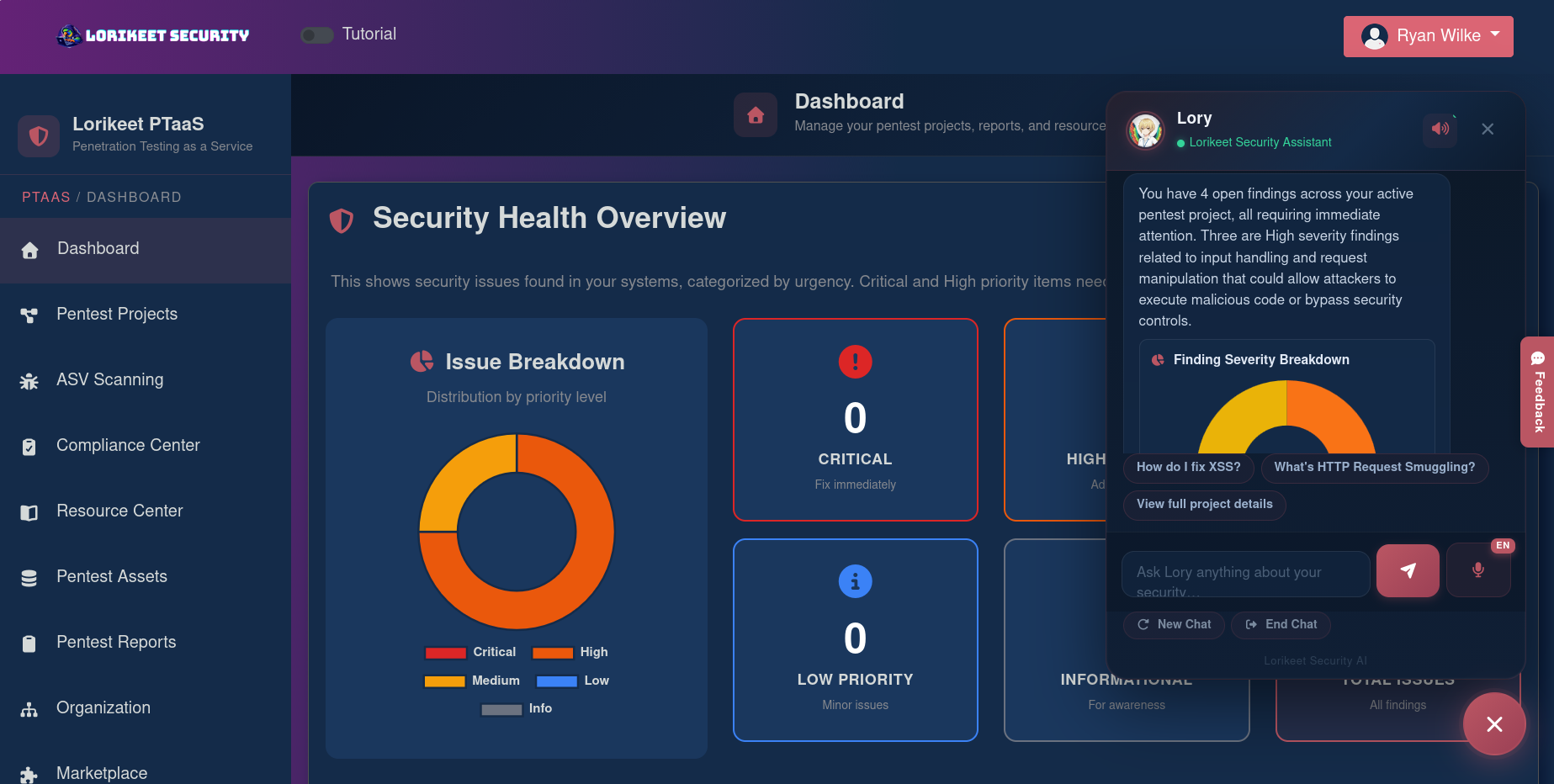
- Lory, the AI assistant
- Trained on ~2,000 vulnerability entries; ask for exploit paths or remediation code samples.
- Example: “Generate a safe deserialization patch for Java Spring” and attach to the Jira issue.
- Security awareness and CTFs
- Phishing simulations and interactive training with compliance-ready analytics.
- Run a Parrot CTF to reinforce lessons after a red team engagement.
Step 3: Pro Tips for SaaS Professionals
- Vibe Check for AI-heavy apps: Use Lorikeet’s AI agent security assessments plus “vibe coding security reviews” to catch prompt injection, tool abuse, and unsafe plugin scopes.
- Reduce MTTR with triage rules: Auto-route P1 findings on auth/crypto to platform engineering; send content security issues to frontend guild; set SLA clocks by criticality.
- Pre-prod safety nets: Add staging/preview URLs to monitoring so misconfigs are caught before Promotion Friday. Weekend Project: run a scoped 24-hour mini-red-team on your feature flags service.
- Compliance without drag: Use control mapping to cover multiple frameworks in one pass; export audit-ready evidence monthly to avoid quarter-end scrambles.
Common Mistakes to Avoid
- Treating it as a one-off pentest
- Fix: Pair every assessment with continuous monitoring and schedule retests immediately after deploys.
- Incomplete asset inventory
- Fix: Import cloud accounts and tag ephemeral resources; review “newly discovered assets” weekly.
- Remediation in a vacuum
- Fix: Connect Jira/Slack, attach Lory’s remediation snippets, and set team-level SLAs with automatic escalations.
How It Compares to Alternatives
- Flowtriq
- While [Flowtriq] excels at instant DDoS detection and auto-mitigation to safeguard uptime at the network edge (a win for SRE and ops), Lorikeet Security is better suited for deep application logic testing, cloud misconfiguration discovery, and audit evidence management. In short: [Flowtriq] minimizes availability risk; Lorikeet minimizes breach and compliance risk. Many teams use both for layered defense.
- Bug bounty platforms
- Great for broad researcher reach but variable signal quality. Lorikeet’s 100% manual, scoped engagements and free retesting yield higher signal-to-noise and predictable MTTR.
Conclusion: Is Lorikeet Security Right for You?
For SaaS teams that want measurable security outcomes without orchestration overhead, the data shows Lorikeet’s platform layer—live portal, continuous monitoring, compliance automation, and Lory—compresses time from finding to fixing. If your priority is resilience against volumetric attacks, add [Flowtriq] for DDoS. If your mandate is to prevent breaches, ship secure code, and pass audits with less friction, Lorikeet is an Easy Setup Tool that earns a Chill Pick. Our recommendation: start with attack surface monitoring plus an app/API pentest, wire in Jira/Slack, and track MTTR and control coverage from day one.